
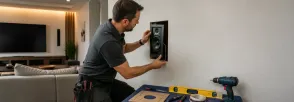
Get Your Quote for In-Wall Speaker Installation
Fill the form below to inquire about Electrical Services Ontario's In-Wall Speaker Installation in Innisfil.
Call Electrical Services Ontario at (289) 672-2825 for In-Wall Speaker Installation in Innisfil and get sound at ear height.
Fill the form below to inquire about Electrical Services Ontario's In-Wall Speaker Installation in Innisfil.
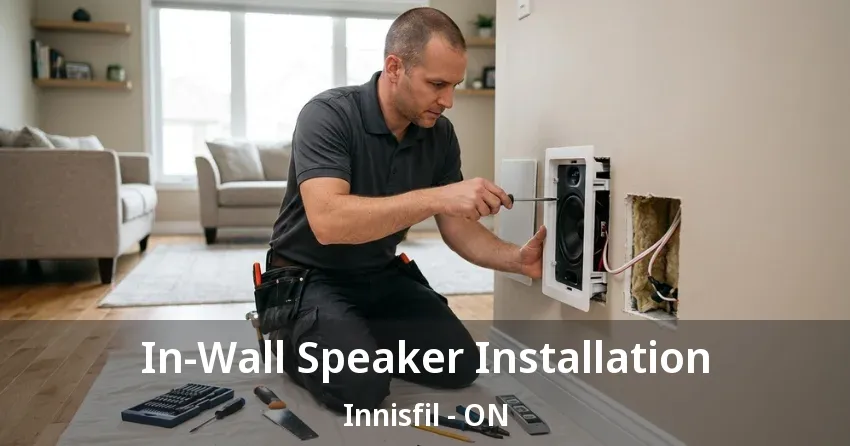
Ceiling or wall is the first real decision in any built-in speaker project, and getting it backwards means living with weaker stereo imaging for years. Our team delivers In-Wall Speaker Installation Innisfil with the front-channel accuracy a ceiling speaker simply cannot match.
Electrical Services Ontario treats the ceiling-versus-wall decision as the starting point of every In-Wall Speaker Installation Innisfil project, not an afterthought decided by whichever surface happens to be more convenient to cut into. Getting this choice right at the planning stage saves homeowners from a common regret: a front channel that never quite locks into a stereo image because it was mounted overhead instead of at ear height where it belongs.
Stereo imaging, the sense that a voice or instrument sits at a specific point in space rather than just coming from a general direction, depends heavily on speakers being at or near ear height. A ceiling speaker firing down from above can deliver good coverage for background music, but it fundamentally cannot recreate the precise left-right-center imaging that a properly placed wall speaker achieves.
This distinction matters most for front channels in a home theatre or a dedicated listening space, where imaging accuracy is the whole point. For background or multi-room audio where even coverage matters more than pinpoint imaging, ceiling placement often makes more practical sense. In-Wall Speaker Installation Innisfil is the right call specifically when the listening experience depends on knowing where each sound is coming from.
Every In-Wall Speaker Installation Innisfil starts with locating wall studs and any obstructions inside the cavity, since a speaker cutout landing on a stud means shifting position or notching into framing that should stay intact. Our technicians use a stud finder and a small inspection hole before committing to a full cutout, the same disciplined approach that prevents a patched mistake next to the finished speaker.
Once the position is confirmed at the correct ear-height elevation for the room's primary seating, we cut the mounting hole to the speaker's exact template, run speaker wire from the amplifier location through the wall cavity, and secure the speaker using its built-in dog-leg clamps or mounting brackets. Getting the height right matters as much as getting the horizontal position right, since a front channel mounted too high or too low undercuts the same imaging accuracy that made wall placement the right choice in the first place.
A freestanding speaker sits inside a purpose-built enclosure engineered specifically for how that driver moves air. An in-wall speaker instead uses the wall cavity itself as its enclosure, which is a much less predictable space acoustically since cavity depth, insulation, and adjacent framing all affect how the driver actually performs.
Better in-wall models include a back-box or an acoustic dampening material designed to control this variability, giving the driver something closer to a proper enclosure even inside a standard wall cavity. Homes across Innisfil with older, uninsulated wall cavities sometimes need a back-box specifically to control resonance and rattling that an insulated modern cavity would naturally dampen. Newer construction with dense insulation packed into every stud bay behaves more predictably without a back-box, though even then the cavity's exact depth and stud spacing still shape the final sound in ways a sealed enclosure would not.
Placing a front left and right channel at consistent ear height, flanking the screen or listening position symmetrically, is what creates a convincing stereo image where sound genuinely seems to originate from a specific point rather than two general directions. Even a few inches of height mismatch between the left and right channel measurably degrades this effect.
Rooms across Innisfil with uneven ceiling heights or angled walls sometimes make matching left-right height trickier than a straightforward rectangular room, which is exactly the kind of layout that benefits from a technician measuring rather than eyeballing symmetric placement. We measure from the primary seating position outward to both proposed speaker locations, confirming the distances and heights are genuinely symmetric before any cutting begins, since a small measuring error compounds into a noticeable imaging problem once the system is playing.
Front channels in a dedicated theatre benefit most from in-wall placement because imaging accuracy is the primary goal, and the front three channels, left, center, right, are exactly where that precision matters most. Surround and height channels in the same room can reasonably move to ceiling placement, since imaging precision matters less for effects and ambience than it does for dialogue and the front soundstage.
Whole-home background audio projects across Innisfil tend to favor ceiling placement throughout, reserving in-wall speakers specifically for a dedicated theatre or listening room where the imaging benefit actually gets used. Mixing placement types within a single project based on each channel's actual job, rather than choosing one method for the whole house, produces the best result for both budget and performance.
A sealed back-box isolates the speaker from the wall cavity entirely, controlling bass response predictably regardless of what is actually inside that particular wall. This makes bass performance consistent from room to room and reduces the chance of sound leaking into an adjacent room through a shared cavity.
Open-back models rely on the cavity itself for some of their bass loading, which can work well in a deep, well-insulated wall but performs unpredictably in a shallow or poorly insulated one. Sealed back-box enclosures cost more upfront but remove the guesswork, which is why we default to recommending them for front channels where consistent, accurate bass matters most. The added cost is usually modest relative to the total project, and it is one of the easiest upgrades to justify since it protects the imaging accuracy that is the entire reason for choosing in-wall placement in the first place.
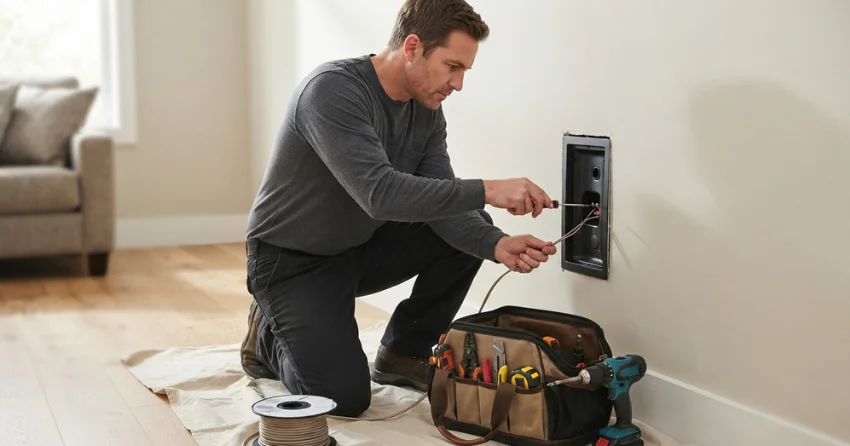
Installing a set of two in-wall speakers, including wiring, typically costs $600 to $1,200, with a per-speaker range of roughly $215 to $510 once the specific speaker model and wiring complexity are factored in. A straightforward In-Wall Speaker Installation Innisfil in an accessible, uninsulated wall sits toward the lower end, while a finished, insulated wall requiring extensive fishing or a sealed back-box sits higher.
The specific speaker model chosen also affects the total, since a sealed back-box design and a premium driver cost meaningfully more than a basic open-back model, though the performance difference is usually worth it for front channels specifically. Call (289) 672-2825 or contact us to get a quote specific to your room, and expect a clear breakdown of what is driving your particular estimate once a technician has assessed the wall.
Most in-wall speaker projects happen in homes with walls that are already finished and painted, not open studs during construction. Our technicians fish wire for In-Wall Speaker Installation Innisfil through existing wall cavities using flexible bits and fish tape, minimizing the drywall opening needed to route cable from the speaker location back to the amplifier.
Homes across Innisfil with insulated exterior walls present more of a challenge than interior partition walls, since insulation can make fishing significantly harder and sometimes calls for an alternate wiring path along an accessible route like a baseboard or an adjacent closet. Every retrofit gets assessed individually based on the specific wall's construction rather than assuming a single technique fits every situation. An interior partition wall between two rooms is usually the easiest retrofit we handle, since it typically has no insulation at all and gives a fish tape a clear, open path from top to bottom.
Several signs point to an in-wall installation that skipped proper technique. Recognizing them helps determine whether a fix is a simple adjustment or a full reinstall. Catching these early usually means a repositioning rather than a complete redo, which saves both time and the cost of patching a second set of holes. Symmetric ear-height placement is the single detail most responsible for whether a front stereo pair images correctly once everything is finished.
Any of these signs justifies having a technician assess the installation. In many cases the speakers themselves are fine and the fix is a repositioning, a sealed back-box retrofit, or a wiring correction rather than full replacement.
Electrical Services Ontario is fully licensed and insured, and every in-wall speaker installation across Innisfil is backed by a satisfaction guarantee on the finished result. With 15 years of experience matching speaker placement to what each room and each channel actually needs, our technicians never default to one method just because it happens to be faster.
We are upfront when a wall's construction genuinely limits placement options, and we never recommend an open-back speaker in a cavity that calls for a sealed enclosure just to save on cost. That honesty is why homeowners across Innisfil trust our team with front-channel and whole-home projects alike rather than piecing together different installers for different rooms, and why so many clients return to us for a second room once the first is finished.
A correctly installed In-Wall Speaker Installation Innisfil with an appropriately chosen enclosure type typically performs at its original level for 12 to 15 years or longer, since the drivers themselves are not subject to the same wear factors as moving mechanical parts elsewhere in a home. The wall cavity and mounting hardware, once installed correctly, essentially never need attention again.
The main reason performance degrades over time in homes across Innisfil is not the speaker itself but changes to the room around it, new furniture, different flooring, or drywall repairs near the speaker that were not done carefully. A speaker that suddenly sounds different after unrelated renovation work nearby is worth having checked, since a nail or screw driven too close to the cavity during other work can occasionally damage a wire run without anyone noticing immediately.
An in-wall speaker's trim ring or grille sits directly against the wall's painted surface, which means color matching matters more here than it does for a ceiling speaker blending into a typically white or off-white ceiling. Most manufacturers offer paintable grilles specifically so the trim can be matched exactly to the surrounding wall color rather than standing out as an obvious white rectangle against a colored wall.
Homes across Innisfil with textured walls, such as a light knockdown or orange peel finish, sometimes need the trim ring's edge blended slightly with joint compound before painting to avoid a visible seam where the flat trim meets textured drywall. This is a small finishing detail, but it is the difference between a speaker that reads as part of the wall and one that reads as an obvious retrofit.
A front soundstage that actually images correctly, with dialogue anchored precisely at the screen and music that feels like it comes from a real point in the room, changes how a theatre or listening space performs compared to speakers placed by convenience. Electrical Services Ontario handles the full process for homes across Innisfil, from stud location through final wiring, so the finished result performs the way accurate placement is supposed to.
Whether the project is a dedicated front-channel install or a broader system where wall and ceiling placement both play a role, our approach stays the same: measure for symmetry, choose the enclosure type the wall actually calls for, and wire cleanly. Simply contact us or call (289) 672-2825 and our team will assess your walls and provide a clear quote before any cutting begins.
Every service call starts with a unique situation. Here are the common issues customers contact us about and how our team handles them.

Tell us what is happening — no power, a breaker that will not reset, or a planned upgrade. We talk it through and book a time that works for you, including same-day for urgent calls.
A licensed electrician looks at the actual panel, circuit, and load rather than quoting over the phone, then gives you a firm written price with the scope set out line by line.
The electrician who quoted the job does the work. Drop sheets go down, permits are filed where the work calls for it, and you get an update before anything changes from the plan.
Every circuit is tested before we close the panel, the inspection is booked and the certificate handed over, and our labour is warrantied for two years.
Reach out to Electrical Services Ontario for panel upgrades, rewiring, EV chargers, generators, or emergency electrical repairs across Innisfil.
Call, or send a message through the form below, either way an electrician gets back to you rather than a call centre.
CALL US (289) 672-2825 EMAIL US Click to send a messageYour message stays between us.

