

Get Your Quote for Intercom And Access Integration
Fill the form below to inquire about Electrical Services Ontario's Intercom And Access Integration in Ontario.
Ring Electrical Services Ontario on (289) 672-2825 for Intercom And Access Integration in Ontario and release the door remotely.
Fill the form below to inquire about Electrical Services Ontario's Intercom And Access Integration in Ontario.

A visitor buzzes the intercom, someone inside presses talk, and the door unlocks with no record of who approved it. Intercom and Access Integration Ontario connects that conversation directly to the credential system, so every buzz-in becomes a logged, accountable decision.
Most buildings install an intercom and an access control system as two separate purchases at two separate times across Ontario, which means neither system actually knows what the other is doing. A resident can see a delivery driver on camera and press unlock, but that action never shows up in the same access log as the tenant who tapped a key fob five minutes earlier. Electrical Services Ontario closes that gap by wiring the intercom's release function directly into the same access control platform managing every other door, so the property finally has one complete picture instead of two disconnected ones.
An intercom's core job is communication: letting someone inside see and speak with a visitor before deciding whether to let them in. Access control's core job is credential management: tracking exactly who has permission to enter and when for properties in Ontario. These are genuinely different systems built by different manufacturers, which is why a huge share of buildings end up with an intercom that can trigger a door strike but has no idea what the access control system is doing at that same door.
The result is a visible gap in the property's access history around Ontario. A resident's tap-in shows up perfectly in the access log, while a visitor buzzed in by that same resident shows up nowhere, or only as a generic "intercom release" with no context about who approved it. Integration closes this gap so every entry, regardless of method, lands in one unified record.
A properly integrated system ties the intercom's call, video, and release functions into the same platform managing card readers, keypads, and mobile credentials at every other door in the building around Ontario. When a resident buzzes in a visitor, that event logs with a timestamp, the resident's identity, and, where video is involved, a saved clip of who was let in.
This integration also lets property managers apply the same access rules across both systems in Ontario instead of managing two separate rule sets. A visitor granted temporary access through the intercom can be automatically restricted to the lobby and denied entry to interior doors, the same way a temporary credential would be restricted if issued directly through the access control platform.
Analog intercoms use dedicated wiring, typically a two-wire or coaxial run, to carry audio and video between the entrance panel and each unit's station in Ontario. This wiring is reliable and does not depend on network uptime, but it integrates with access control in a limited way, usually through a simple relay connection rather than a genuine shared platform.
IP intercoms transmit audio, video, and door control over the building's network throughout Ontario, often using Power over Ethernet so a single cable handles both connectivity and power. This architecture is what makes real integration possible: an IP intercom can talk to an access control platform using open protocols, share credential databases, and log every event to the same system rather than operating as a bolted-on accessory.
Older buildings with existing analog wiring around Ontario sometimes get more value from a targeted relay integration than a full IP replacement, especially when the analog system is otherwise functioning well and the building has no other reason to touch its network infrastructure. This approach preserves the reliability of dedicated wiring while still connecting release events to the access control log, which covers most of what a building actually needs without the cost or disruption of a full rewire. A property with a tight renovation budget or a heritage building with restrictions on new cabling often lands here by necessity as much as personal preference, and there is nothing wrong with that choice when the underlying hardware is sound and well-maintained already.
Buildings with more than ten units, multiple entrances, or plans to add mobile credentials down the line generally get a noticeably better long-term return from IP intercoms, since the integration depth and remote management capability scale with the property in a way analog cannot match. The higher upfront hardware cost is usually fully offset within a few years by lower ongoing management overhead and the ability to add new features without new wiring throughout the building or its common areas. Growing properties in particular benefit from this flexibility, since adding a new entrance later becomes a straightforward software configuration rather than a fresh cabling project across the whole building and its shared spaces, saving both time and disruption to residents.
One of the most valuable outcomes of proper integration is a saved video clip attached directly to each access event rather than a separate camera feed a property manager has to cross-reference manually in Ontario. When a door opens, the system captures who triggered it and what the camera saw at that exact moment, all stored together. This eliminates the guesswork of matching a rough timestamp from one system against footage from another, which used to be the only practical way to piece together what actually happened at a specific entrance.
This matters most when investigating a disputed entry or confirming who let a specific visitor into the building near Ontario. Instead of scrubbing through hours of raw camera footage hoping to match a timestamp, a property manager pulls the exact clip tied to the access event in question within seconds. For properties dealing with package theft or unauthorized access complaints, this single feature often justifies the entire cost of integration on its own.
Modern integrated systems let residents answer intercom calls, view live video, and release the door directly from a smartphone app in Ontario, regardless of whether they are home. This removes the awkward scenario of a resident missing a delivery because they were not near the wall-mounted station when the buzzer rang, which is one of the most common frustrations we hear about from residents in buildings running older, unintegrated hardware.
The same app typically manages the resident's own door and building credentials around Ontario, so there is no separate login or device needed to handle both intercom calls and everyday access. Property managers configure this unified experience during setup rather than leaving residents to figure out two different apps for two related functions, which cuts down significantly on support calls once the system goes live.
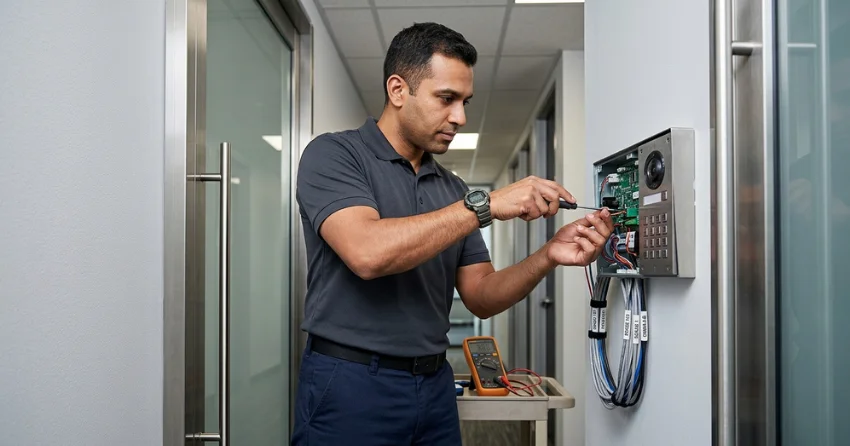
Office buildings and mixed-use properties throughout Ontario use intercom integration differently than residential buildings, since the goal is usually screening visitors before they reach a specific tenant floor or suite rather than simply unlocking a shared front door. Two specific configurations come up most often in commercial installations across many different property types. Both are covered below in more detail for property managers weighing which approach best fits their specific building layout and staffing model, since the right choice depends heavily on how the lobby is actually used day to day. Many properties end up using a combination of both configurations depending on the time of day and who is available to answer calls at that particular hour of operation.
A receptionist or security desk can screen calls in what many systems call reception mode for buildings throughout Ontario, forwarding only verified visitors to the relevant tenant. This layered approach adds a real screening step that a simple buzz-in intercom cannot provide on its own, giving staff a genuine gatekeeping role rather than a passive door release button. Buildings with a staffed lobby during business hours get the most value from this configuration, since it puts a person in the loop for every visitor decision. Outside business hours, the same system can automatically switch to direct resident or tenant calling without any manual reconfiguration, so nobody is left waiting on an unanswered desk line late in the evening or on a weekend.
Delivery and postal access is a common addition for commercial and mixed-use properties, since a dedicated release path for couriers avoids tying up staff or residents every time a package needs to come through. Our team configures these specialized access paths as part of the integration rather than treating deliveries the same as any other visitor, since a courier making dozens of stops a day needs a faster, more predictable process than a one-time guest. This dedicated path also keeps a separate access record for delivery personnel, distinct from general visitor traffic. That separation simplifies reviewing activity later and settling any disputes about missed or misdelivered packages between residents and building staff over the course of daily operations at a busy property.
A project starts with an assessment of the existing intercom and access control hardware, since the Intercom and Access Integration Ontario approach differs significantly depending on whether the building has analog wiring, an existing IP system, or no intercom at all yet. Our technicians document every entrance, its current release method, and how residents currently handle visitor access before proposing a specific integration path tailored to what the building already has in place.
Installation typically involves connecting the intercom's release output to the access control panel throughout Ontario, configuring the credential database to recognize intercom-triggered events, and testing every entrance individually to confirm calls, video, and door release all function correctly together. This testing phase catches configuration issues before residents encounter them on their own, which matters most for a system residents will rely on daily once it goes live.
Certain situations point clearly to a building where the intercom and access control systems are operating as strangers rather than partners, and where Intercom and Access Integration Ontario would solve the underlying problem. Recognizing these signs early helps property managers plan the upgrade before a security gap turns into an actual incident.
Any one of these situations justifies scheduling an assessment, and buildings dealing with several at once typically see the fastest improvement once integration is complete.
Typical costs for Intercom and Access Integration Ontario range from $1,500 to $7,000 per entry point depending on whether the building has existing IP infrastructure, how many entrances need integration, and whether video verification and mobile app access are included. A straightforward integration on an existing IP intercom sits toward the lower end, while a full analog-to-IP upgrade with multiple entrances sits higher. Contact us via contact us or call (289) 672-2825 to get a quote specific to your building.
Multi-entrance properties throughout Ontario typically see costs scale more efficiently once network infrastructure and credential management are planned across the whole building rather than entrance by entrance, since much of the platform setup work only needs to happen once for the entire property. Ongoing software subscription costs for cloud-managed systems are a separate line item our team explains clearly during the quote process, so there are no surprises once the system is live and billing month to month.
Electrical Services Ontario is fully licensed and insured, and every Intercom and Access Integration Ontario project is backed by a satisfaction guarantee on the finished system. With 15 years of experience across residential and commercial access control work, our technicians know which intercom and access control platforms genuinely integrate well together before a single component is ordered. That knowledge saves property managers from discovering an expensive compatibility problem partway through a project.
We never recommend a full system replacement when a targeted integration will accomplish the same result at a fraction of the cost, and we are upfront when a building's existing hardware genuinely limits what integration can achieve. That honesty is why property managers throughout Ontario trust our team with projects ranging from a single entrance retrofit to full multi-building rollouts.
Before deciding between a full IP replacement and a targeted integration of existing hardware, a proper assessment of what your building already has is the right first step for properties in Ontario. Electrical Services Ontario documents the intercom type, the access control platform in use, and every entrance's current wiring before recommending a specific approach, so the proposal actually fits the building rather than defaulting to the most expensive option available on the market.
Call (289) 672-2825 or contact us and our team will confirm a time to assess your intercom and access control setup around Ontario, and walk through exactly what integration would involve for your specific property, including a realistic timeline and cost range before any commitment is made. Most assessments can be scheduled within a few days and take under an hour to complete fully for a standard residential or small commercial building.
Every service call starts with a unique situation. Here are the common issues customers contact us about and how our team handles them.

Tell us what is happening — no power, a breaker that will not reset, or a planned upgrade. We talk it through and book a time that works for you, including same-day for urgent calls.
A licensed electrician looks at the actual panel, circuit, and load rather than quoting over the phone, then gives you a firm written price with the scope set out line by line.
The electrician who quoted the job does the work. Drop sheets go down, permits are filed where the work calls for it, and you get an update before anything changes from the plan.
Every circuit is tested before we close the panel, the inspection is booked and the certificate handed over, and our labour is warrantied for two years.
Reach out to Electrical Services Ontario for panel upgrades, rewiring, EV chargers, generators, or emergency electrical repairs across Ontario.
Call, or send a message through the form below, either way an electrician gets back to you rather than a call centre.
CALL US (289) 672-2825 EMAIL US Click to send a messageYour message stays between us.

