

Get Your Quote for Low-Voltage Cable Testing
Fill the form below to inquire about Electrical Services Ontario's Low-Voltage Cable Testing in Ontario.
Phone Electrical Services Ontario at (289) 672-2825 for Low-Voltage Cable Testing in Ontario and get results you can hand over.
Fill the form below to inquire about Electrical Services Ontario's Low-Voltage Cable Testing in Ontario.
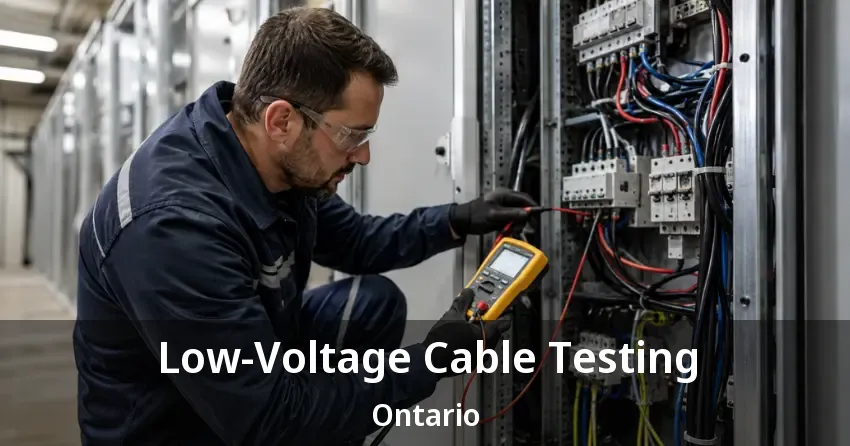
A cable that looks properly installed can still fail under real network load if nobody actually tested it. Low-Voltage Cable Testing Ontario confirms every run performs to specification before it becomes someone else's problem months later.
Not every technician who can pull and terminate a cable can properly certify it, and that distinction matters more than most homeowners and business owners realize until a network problem traces back to a connection nobody ever verified. Electrical Services Ontario treats certification testing as a distinct skill, backed by calibrated equipment and documented results, not a quick continuity check performed as an afterthought. The difference between a tested cable and an untested one is invisible on installation day and becomes very visible the first time that connection gets pushed to its actual limit, often at the worst possible moment for whoever is relying on it.
Proper cable testing requires calibrated certification equipment and training on how to interpret the results it produces, not just the ability to run a basic continuity check. A technician certifying cable to ANSI/TIA-568 standards needs to understand what parameters like near-end crosstalk, return loss, and insertion loss actually indicate about a cable's real-world performance, not just whether the tester displays a pass or fail. This distinction between running a test and understanding what the results actually mean is exactly what separates genuine certification from a quick check performed to satisfy a checklist item.
Across Ontario, the gap between a properly trained technician and someone running Low-Voltage Cable Testing Ontario with only a basic tester shows up in the documentation produced, not necessarily in the pass rate on a good day. A qualified technician catches marginal passes that will likely fail under future load, while a less experienced one only catches outright failures that were already obvious.
Owning a certification tester does not automatically make someone qualified to interpret what it reports. Understanding how environmental factors, cable quality, and installation technique interact to affect the underlying measurements takes real training beyond simply knowing which button starts the test.
A Low-Voltage Cable Testing Ontario visit starts with confirming which standard applies to the project, since testing a Cat6A cable against Cat6 limits produces a technically passing result that is functionally meaningless for the higher-bandwidth application it was actually installed for. Getting this baseline right before testing begins is the single most important step in the entire process, since every measurement that follows depends on comparing results against the correct set of limits.
Every cable gets tested individually using calibrated certification equipment, not a sample selected at random from the total run count. A project with 200 drops installed should produce 200 individual test results, since sampling a subset and extrapolating the rest is not certification, regardless of how the results get presented afterward. Matching the drop count on the test report to the actual cable schedule is a simple check that reveals whether a project was genuinely certified or only partially tested, and it takes a client only a few minutes to verify.
A pass or fail result is only a summary of what proper Low-Voltage Cable Testing Ontario actually delivers in a full report. Margin analysis on the underlying parameters tells a technician whether a cable run passed comfortably or barely scraped by, information that matters significantly for predicting how that connection will perform as network demands increase over time.
A cable that passes with minimal margin today is a cable likely to fail once additional load gets placed on the network, even though nothing about the physical cable itself has changed. Reading the margins, not just the pass/fail summary, is what separates a technician who understands certification from one who is simply reading a green light on a screen. A client who only sees "PASS" on a summary sheet has no way to know which of those results are genuinely solid and which are one firmware update or one additional device away from failing under real conditions.
Not every tool marketed as a cable tester actually performs certification. Verification testers, sometimes miscalled speed certifiers, confirm basic connectivity and wire mapping but do not measure the detailed performance parameters that a real certification requires. Using the wrong tool for the job produces results that look official without carrying any actual certification value, which is a distinction most clients only discover the hard way. Knowing the difference before hiring a contractor is the easiest way to avoid that surprise entirely, and it costs nothing to simply ask which type of equipment a contractor plans to use before work begins. A five-minute conversation upfront can save a great deal of confusion and expense later on, well before any cable actually gets pulled.
A verification tester confirms that a cable is wired correctly end to end, catching obvious problems like miswires, opens, and shorts. This is useful information, but it stops well short of confirming whether a cable will actually perform to a given bandwidth standard under real-world conditions, which is exactly the gap a genuine certification test is designed to close. A cable can pass basic wire-mapping and still fail a real certification once crosstalk and signal loss are actually measured, which is the exact scenario a verification-only test can never catch on its own. This is why the two tools serve genuinely different purposes rather than being interchangeable options at different price points, and confusing one for the other is a common and costly mistake.
Certification testers measure parameters like near-end crosstalk, return loss, insertion loss, and propagation delay against the specific limits defined by a chosen standard. The added cost of this equipment, often thousands of dollars more than a basic verification tester, reflects genuine measurement capability rather than a markup, and it is the only equipment that produces a result a manufacturer will actually accept for warranty purposes. A contractor using the cheaper tool simply cannot produce the documentation a real certification requires, regardless of how confident the results look on their screen. Asking what equipment a contractor actually uses is a fair and reasonable question before hiring anyone for this work, and a contractor confident in their process should have no trouble answering it directly.

The native test file format produced by certification equipment, not the PDF summary generated from it, is the authoritative record a manufacturer requires for warranty registration and the baseline every future troubleshooting effort compares against. A PDF alone tells a client the cable passed. The native file tells a technician years later exactly what the margins looked like on installation day, information that becomes essential the moment something needs diagnosing.
Homeowners and businesses throughout Ontario should specifically request the native file format when hiring for Low-Voltage Cable Testing Ontario, since a contractor who cannot produce it either did not actually certify the cabling or is not keeping proper records of work that was genuinely done. This distinction rarely comes up until it matters, at which point its absence becomes a real and costly problem.
Testing during a new installation confirms the work was done correctly before the project closes out, catching termination errors or damaged cable while the crew is still on site and able to fix the problem immediately. This is the ideal time to test, since fixing an issue found during installation costs a fraction of what the same fix costs after walls are closed and the crew has already moved to another project entirely.
Testing existing cabling across Ontario serves a different purpose: confirming whether an older or unknown system still meets the performance a current application actually needs. A cable that tested fine for a 100-megabit network years ago may not have the margin to reliably support a modern gigabit connection, which only testing reveals with certainty rather than assumption. This kind of verification matters most before a business commits budget to new equipment that assumes the underlying cabling can actually keep pace with it.
Several recurring issues show up repeatedly during certification testing. Understanding what causes each one helps set realistic expectations before testing begins.
Most failures trace back to installation practices rather than defective cable itself, which is why testing during installation catches problems while they are still cheap and simple to correct. A failure discovered years later, after the cable is buried in a finished wall, costs considerably more to diagnose and fix properly, since accessing the run at that point often requires opening a wall or ceiling that was never meant to be reopened.
Cable manufacturers typically require documented certification testing before extending a system warranty on installed cabling, since the warranty covers performance to a specific standard that only testing can actually confirm. Skipping certification to save money on a new installation can quietly void warranty coverage that a client assumed was already in place, a gap that often only surfaces years later when a claim actually needs to be filed.
Property managers and businesses across Ontario pursuing manufacturer-backed warranties on new Low-Voltage Cable Testing Ontario and installations should confirm testing requirements before the project starts, not after installation is complete and the paperwork gets requested. Retroactively certifying an already-installed system is possible but adds cost and complexity that proper sequencing avoids entirely, since a technician has to work around finished walls and completed terminations that a new installation never has to contend with.
Low-Voltage Cable Testing Ontario with Electrical Services Ontario is priced starting from $99 to $299 for smaller projects, with per-drop pricing available for larger commercial installations depending on cable count and category. A single-room network with a handful of drops sits toward the lower end, while a full commercial certification project with hundreds of drops is quoted based on scope.
Call (289) 672-2825 or contact us to get a quote specific to your project, and expect a clear explanation of Low-Voltage Cable Testing Ontario scope and deliverables before work begins. Homeowners and businesses throughout Ontario receive the native test file alongside any summary report, so the documentation holds real value years after the testing visit is complete, not just on the day it was performed.
Electrical Services Ontario is fully licensed and insured, and every cable testing project is backed by a satisfaction guarantee on the accuracy of the results delivered. With 15 years of experience certifying cabling systems for residential and commercial clients, our technicians test to the correct standard for the application rather than whichever standard happens to produce a passing result.
We never present a marginal pass as a clean result without explaining what the margin actually means for future reliability. That honesty is why property managers and IT teams around Ontario trust Electrical Services Ontario with certification work. They prefer this over accepting a quick pass/fail summary from whoever quoted the lowest price, since a cheap certification that does not hold up under scrutiny is not actually a savings at all.
An untested cable installation is a guess dressed up as a finished project, and the cost of discovering that guess was wrong grows substantially the longer it goes unverified. Electrical Services Ontario tests every drop individually and hands over documentation that actually holds up when a warranty claim or a future troubleshooting call depends on it.
New installations and existing systems throughout Ontario both benefit from proper certification testing, whether the goal is confirming new work or verifying an older system still fully meets today's demands. A network tested and documented correctly the first time saves both money and frustration on every issue that comes up afterward.
Call (289) 672-2825 or contact us today and our team will put together a testing plan scoped specifically to your project.
Every service call starts with a unique situation. Here are the common issues customers contact us about and how our team handles them.

Tell us what is happening — no power, a breaker that will not reset, or a planned upgrade. We talk it through and book a time that works for you, including same-day for urgent calls.
A licensed electrician looks at the actual panel, circuit, and load rather than quoting over the phone, then gives you a firm written price with the scope set out line by line.
The electrician who quoted the job does the work. Drop sheets go down, permits are filed where the work calls for it, and you get an update before anything changes from the plan.
Every circuit is tested before we close the panel, the inspection is booked and the certificate handed over, and our labour is warrantied for two years.
Reach out to Electrical Services Ontario for panel upgrades, rewiring, EV chargers, generators, or emergency electrical repairs across Ontario.
Call, or send a message through the form below, either way an electrician gets back to you rather than a call centre.
CALL US (289) 672-2825 EMAIL US Click to send a messageYour message stays between us.

