

Get Your Quote for Low-Voltage Cable Labelling
Fill the form below to inquire about Electrical Services Ontario's Low-Voltage Cable Labelling in Lucan.
Ring Electrical Services Ontario on (289) 672-2825 for Low-Voltage Cable Labelling in Lucan and stop guessing at both ends.
Fill the form below to inquire about Electrical Services Ontario's Low-Voltage Cable Labelling in Lucan.

Low-Voltage Cable Labelling Lucan turns a rack full of unmarked cables into a system anyone can service in minutes instead of hours. A properly labeled system pays for itself the first time something needs troubleshooting.
A network that works perfectly on day one can still become a nightmare to maintain if nobody can tell which cable goes where. Electrical Services Ontario treats labeling as a core part of every cabling project, not an optional add-on saved for whenever there is time left in the budget. The difference between a labeled system and an unlabeled one rarely shows up during installation. It shows up months or years later, during the first emergency troubleshooting call that a proper label set would have resolved in minutes instead of hours.
A properly labeled cabling system has every cable, patch panel port, and outlet marked with a consistent identifier that traces directly back to a documented record. Anyone who picks up the documentation should be able to locate a specific cable's origin and destination without physically tracing the run by hand. This matters as much for a small office network as it does for a large commercial Low-Voltage Cable Labelling Lucan project, since the confusion an unlabeled system creates scales with how often the network gets serviced, not just its size.
Following the TIA-606 standard for labeling and administration keeps a system consistent even when different technicians work on it over the years, since everyone follows the same identifier format rather than inventing their own scheme on the fly.
Unlabeled cabling turns every future service call into a tracing exercise, since a technician has to physically follow a cable from one end to the other to confirm what it connects. This is manageable with a handful of cables and becomes genuinely time-consuming once a rack holds dozens of identical-looking connections.
Across Lucan, businesses that skip labeling during initial installation almost always end up paying for it later, either through longer service visits, mistaken disconnections during unrelated work, or a full re-labeling project once the original installer is no longer available to explain what they built. The labor saved by skipping labeling during installation is small compared to the cost of tracing an undocumented system years later.
A rack with a dozen unlabeled cables might cost a technician twenty extra minutes on a service call, but the same problem on a system with hundreds of cables can add hours to what should have been a routine visit. Investing in Low-Voltage Cable Labelling Lucan before that gap widens keeps every future service call proportional to the actual problem rather than compounded by confusion. That gap widens every time new equipment gets added without documentation, since each addition compounds the confusion the next technician has to untangle.
A Low-Voltage Cable Labelling Lucan project starts with establishing or confirming a consistent identifier scheme, since every label needs to follow the same logic for the system to actually function as documentation rather than just decoration. Our technicians typically use a format that identifies the origin, destination, and cable type in a way that is readable at a glance.
Physical labeling happens at both ends of every cable, at patch panel ports, and at wall outlets, using durable labels rated to stay legible for the life of the installation. A digital record matching every physical label gets created alongside the physical work, so the documentation survives even if a label is damaged or becomes hard to read over time. This dual approach, physical and digital, means the system stays traceable even decades into the future.
The ANSI/TIA-606 administration standard defines proper labeling and record documentation for structured cabling systems, covering everything from cable identifiers to pathway and space labeling. This is not a suggestion contractors follow loosely. It is a documented standard that specifies exactly what information a label needs to convey and how that information should be formatted, and it applies to every element of a structured cabling system, not just the cables themselves.
Consistent identifier formatting across every label in a system is what separates genuinely useful documentation from a collection of stickers that only make sense to whoever applied them. Homes and businesses throughout Lucan that follow this standard from the start avoid the confusion that comes from mixing labeling conventions across different installation phases or contractors.
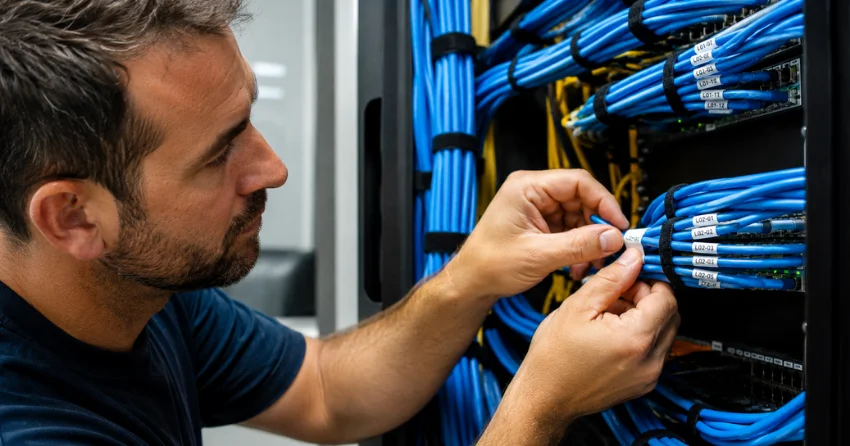
Relabeling an existing system requires tracing every cable's actual path before a single new label goes on, since applying labels based on assumptions rather than confirmed connections creates documentation that is worse than having none at all. This tracing step is the most time-consuming part of any relabeling project, particularly in older buildings with cabling installed by multiple contractors over the years. Each contractor tends to bring their own conventions, or none at all, which means a building's cabling history often reads like several different languages layered on top of each other. Untangling that history is exactly what makes relabeling more involved than it might initially appear, and it is also exactly why the work pays off once it is finally done.
Our technicians across Lucan use signal tracers and continuity testing to confirm every connection before labeling it, rather than guessing based on cable color or approximate location. A relabeling project done this way produces documentation that is actually trustworthy, which matters more for an older system than for a freshly installed one where the installer already knows exactly what was built. Skipping this verification step to save time defeats the entire purpose of the project, since a confidently wrong label is worse than an honest blank. Testing every connection before applying a label is the difference between real documentation and an expensive guess, and it is the step most likely to get skipped by anyone trying to cut corners on price.
A relabeling project typically starts with a full inventory of every cable run, followed by systematic tracing and testing before any labels get applied. Clients should expect the process to take longer than a comparable new installation, since every assumption has to be confirmed rather than simply built in from the start. Larger commercial systems with hundreds of cables may need the work broken into phases across several visits to avoid disrupting ongoing operations, which keeps the business running normally while the documentation project proceeds in the background. Scheduling around off-peak hours can further reduce disruption for systems that cannot tolerate any downtime, and it is a conversation worth having before the project starts rather than mid-way through the visit itself.
Physical labels alone are not documentation. A complete cable labeling project includes a digital record, typically a spreadsheet or dedicated cable management system, that maps every labeled cable to its function and location. This record is what actually survives when the person who understood the original system leaves the company or the original installer is no longer available. A physical label tells a technician what a cable is called, but the digital record tells them what it actually does and why it matters.
Businesses across Lucan with high staff turnover in IT or facilities roles benefit most from thorough digital documentation, since institutional knowledge about an unlabeled network typically leaves the building along with whoever held it. A well-maintained record means a new hire can troubleshoot the network on day one instead of spending weeks rediscovering what a predecessor already knew. This matters even more in facilities where the person managing IT wears multiple hats and cannot dedicate weeks to reverse-engineering a network from scratch. A digital record that goes stale the moment new cabling gets added defeats much of its purpose, since outdated documentation can be more misleading than no documentation at all. Our technicians recommend updating the record every time new cable gets added or existing cable gets rerouted, treating the documentation as a living part of the infrastructure rather than a one-time deliverable.
Several signs point to a cabling system that has fallen behind on documentation. Recognizing them early keeps a small labeling project from becoming a much larger tracing exercise.
Any single sign justifies a professional labeling review before the system grows any larger or more tangled. Multiple signs together usually mean documentation was never maintained consistently, which Low-Voltage Cable Labelling Lucan done properly the first time resolves for good. Waiting until the system becomes completely unmanageable only makes the eventual tracing project larger and more expensive.
Labeling during a new installation costs a fraction of what relabeling an existing system costs later, since every cable already has a known origin and destination at the moment it gets pulled and terminated. Building Low-Voltage Cable Labelling Lucan into the installation workflow adds minimal time to the overall project, since the technician doing the pull already knows exactly what each cable connects.
Retrofitting labels onto an existing system across Lucan requires the tracing work a new installation never needs, which is why relabeling projects typically take longer and cost more per cable than labeling done during original installation. Homeowners and businesses planning any new cabling work should treat labeling as a standard part of the project scope, not an optional upgrade to consider later, since bundling it into the original project avoids a separate mobilization cost entirely. Older buildings with cabling installed across several different phases or contractors almost always need a retrofit labeling project at some point, since waiting for a convenient moment rarely arrives on its own. Budgeting for this work proactively, rather than reacting to a failed troubleshooting call, keeps the project scoped and predictable instead of rushed.
Typical costs for Low-Voltage Cable Labelling Lucan in the area range from $300 to $1,500 depending on the number of cables involved and whether the project requires tracing an existing unlabeled system or labeling new installations as they go. Projects labeling cable during original installation sit toward the lower end, while relabeling an older undocumented system sits higher due to the tracing work involved.
Contact us via contact us or call (289) 672-2825 to get a quote specific to your system, and expect a clear explanation of the scope once the site has been fully assessed. Homeowners and businesses throughout Lucan receive a full digital record alongside the physical labeling, so the documentation holds up even years after the project is complete, regardless of who is on staff by then.
Electrical Services Ontario is fully licensed and insured, and every Low-Voltage Cable Labelling Lucan project is backed by a satisfaction guarantee on the accuracy of the documentation delivered. With 15 years of experience labeling and documenting cabling systems of every size, our technicians follow TIA-606 standards consistently rather than inventing a new scheme for every project, which keeps documentation portable if a client later brings in a different provider.
We never apply labels without confirming the actual connection first, since a mislabeled system creates false confidence that is often worse than having no labels at all. That accuracy is why property managers and IT teams around Lucan trust Electrical Services Ontario with documentation projects rather than treating labeling as a quick afterthought.
An unlabeled cabling system works fine right up until the moment something needs to be traced under pressure, and that is exactly the wrong time to discover nobody knows which cable does what. Electrical Services Ontario builds documentation that holds up long after the original installation team has moved on to other projects.
New installations and relabeling projects throughout Lucan both receive the same rigorous approach: confirmed connections, consistent identifiers, and a digital record that actually matches what is physically in the building. A system labeled correctly the first time saves hours of tracing on every service call for years to come.
Call (289) 672-2825 or contact us and our team will assess the system and put together a labeling plan that makes every future service call faster.
Every service call starts with a unique situation. Here are the common issues customers contact us about and how our team handles them.

Tell us what is happening — no power, a breaker that will not reset, or a planned upgrade. We talk it through and book a time that works for you, including same-day for urgent calls.
A licensed electrician looks at the actual panel, circuit, and load rather than quoting over the phone, then gives you a firm written price with the scope set out line by line.
The electrician who quoted the job does the work. Drop sheets go down, permits are filed where the work calls for it, and you get an update before anything changes from the plan.
Every circuit is tested before we close the panel, the inspection is booked and the certificate handed over, and our labour is warrantied for two years.
Reach out to Electrical Services Ontario for panel upgrades, rewiring, EV chargers, generators, or emergency electrical repairs across Lucan.
Call, or send a message through the form below, either way an electrician gets back to you rather than a call centre.
CALL US (289) 672-2825 EMAIL US Click to send a messageYour message stays between us.

