

Get Your Quote for Smart Home System Integration
Fill the form below to inquire about Electrical Services Ontario's Smart Home System Integration in Orillia.
Call Electrical Services Ontario at (289) 672-2825 for Smart Home System Integration in Orillia and get one app that runs it.
Fill the form below to inquire about Electrical Services Ontario's Smart Home System Integration in Orillia.
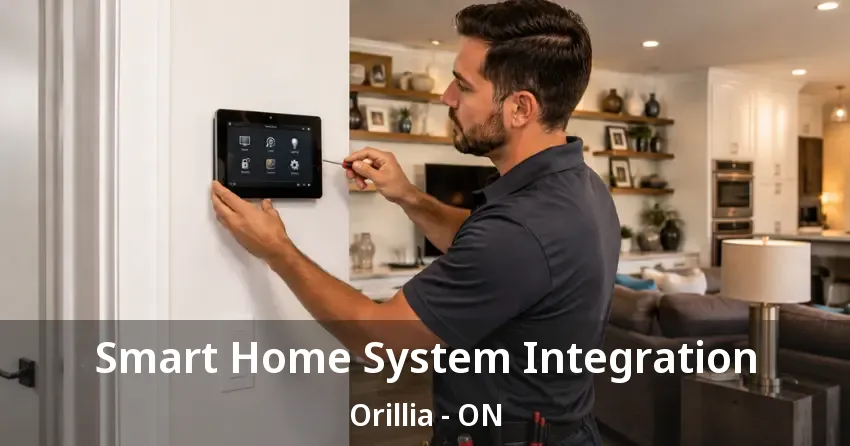
You have already tried juggling five different apps for lights, shades, and the thermostat. Smart Home System Integration Orillia from Electrical Services Ontario brings every device onto one controller with settings that actually stay documented.
A properly integrated smart home does not feel like technology at all once it is finished. One touch dims the lights, lowers the shades, and adjusts the thermostat together, instead of a homeowner opening three separate apps to accomplish what should be a single command. Electrical Services Ontario builds every Smart Home System Integration Orillia project around that outcome, using a unified controller and documented programming that someone other than the original installer can actually understand and adjust later.
A finished Smart Home System Integration Orillia project means lighting, shades, thermostats, and security work from one controller instead of five competing apps, each with its own login, its own quirks, and its own update schedule. A single "Good Morning" scene can raise the shades, shift the lighting to a warmer daylight tone, and nudge the thermostat toward a comfortable temperature, all triggered by one button press or voice command rather than a sequence of separate adjustments.
Homes across Orillia that reach this level of integration report using their systems more, not less, because the friction of managing multiple apps disappears entirely. A scene-based system also adapts to actual routines rather than forcing a household to adapt to the technology, which is the difference between a smart home that gets used daily and one that gets abandoned within a few months of installation.
Most homeowners start with individual smart devices purchased separately over time: a smart thermostat one year, motorized shades the next, a lighting system after that. Each device works fine in isolation, but none of them know the others exist, which means a homeowner ends up manually coordinating actions that should happen automatically together.
This fragmented approach is exactly what Smart Home System Integration Orillia is designed to solve, and it tends to compound as more devices get added. A fourth or fifth smart product does not simplify the home; it adds another app, another account, and another point of failure. By the time a household has six or seven disconnected devices, the smart home has become more work to manage than the manual version it was supposed to replace.
The problem rarely announces itself right away. A household might live comfortably with two or three separate apps for months before the friction becomes obvious, usually the day a guest asks how to turn off the lights and nobody can explain which of four apps controls which room. That moment is often what finally prompts a call for proper integration rather than another standalone gadget.
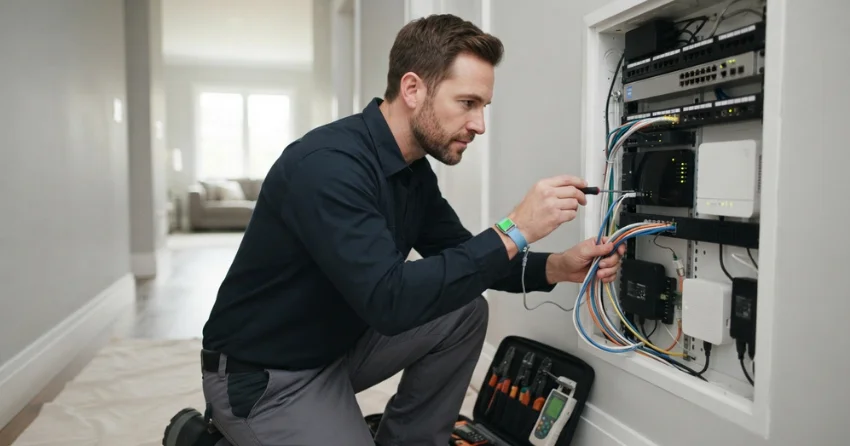
A qualified integrator starts with a controller and protocol selection that fits the specific mix of devices already in the home or planned for it. Zigbee and Z-Wave communicate locally through a hub without depending on cloud servers, which means faster response times and continued function even during an internet outage, while Wi-Fi-based devices route through the router and depend on a stable connection to respond reliably.
Our technicians across Orillia evaluate existing devices for protocol compatibility before recommending anything new, since forcing incompatible ecosystems together usually produces a system that works most of the time but fails unpredictably during the moments that matter most. Choosing a controller that can bridge multiple protocols from the start avoids the common trap of buying into one ecosystem and then hitting a wall when a favorite brand does not support it.
The emerging Matter standard is starting to reduce some of this friction, since it is designed to let devices from different manufacturers communicate without a proprietary bridge. It is not yet universal across every product category, so a technician still needs to confirm real-world compatibility rather than assuming a Matter label guarantees a smooth integration on its own.
A scene is a single command that triggers multiple devices at once, built around how a household actually moves through its day rather than a generic template. "Away" might lock doors, lower the thermostat, and close shades in one action, while "Movie Night" dims the lights and closes shades in the media room without touching the rest of the house.
Building scenes that genuinely reflect daily routines takes more thought than most homeowners expect on their first attempt. Our technicians interview the household about actual habits, not assumed ones, before programming scenes, since a scene that does not match how a family actually lives gets ignored within weeks no matter how well it was built technically. A scene built around a homeowner's real 7am routine, for example, gets used every single morning, while a generic "Wake Up" scene borrowed from a template often sits unused.
Voice assistants like Alexa, Google Assistant, or Apple HomeKit should feel like a convenience layered on top of a working system, not the system itself. Devices connected only through a voice assistant with no underlying hub tend to be slower to respond and more prone to dropping commands during peak network usage, especially in larger homes with several rooms competing for bandwidth.
A well-built system gives every household member appropriate app access on their own device, with permissions that make sense for who lives in the home. Guests or renters can get limited access to specific rooms or functions without full control over the entire property, which matters more than most homeowners realize until the first time it becomes necessary. Setting this up correctly from the start avoids the awkward scramble of trying to revoke access after the fact.
Homes across Orillia with a handful of existing smart devices rarely need to start over completely. Most modern controllers can absorb an existing smart thermostat, a few smart bulbs, or a video doorbell into a unified system without replacing hardware that already works, as long as the protocol is supported.
New construction and major renovations offer more flexibility, since low-voltage wiring for a wired backbone can be planned before walls close. A hybrid approach, wired for reliability where it matters most and wireless for flexibility elsewhere, tends to produce the most resilient result for Orillia homes of any age or construction type.
The decision to retrofit versus rebuild usually comes down to how much of the existing setup is actually working well. A homeowner with three reliable devices and two frustrating ones often only needs the frustrating ones addressed, not a full system replacement. Our technicians assess what is genuinely worth keeping before recommending anything new, since replacing functional hardware just to standardize brands rarely justifies the added cost.
Overcomplicating the initial setup is the most common mistake, where an installer configures dozens of scenes and automations before the homeowner has lived with the basics long enough to know what they actually want. A system with too many options from day one often gets underused simply because nobody remembers how to trigger half of it, and the household eventually reverts to manual switches out of sheer frustration with the complexity.
A properly documented Smart Home System Integration Orillia project leaves behind a clear record of every device, its protocol, and how each scene is programmed. This matters more than homeowners expect until the day a device needs replacing or a new technician gets called in to troubleshoot a specific issue.
Systems without documentation across Orillia properties often force a homeowner to call the original installer for even minor changes, since nobody else can decode the configuration. A documented system stays serviceable by any qualified technician, which protects the investment even if the original installer is no longer available. This becomes especially relevant during a home sale, when a new owner inherits the system and needs a way to understand what they now own.
A properly integrated system typically reduces heating and cooling costs by 10 to 20 percent through coordinated scheduling that a collection of standalone devices cannot achieve on its own. This is one of the clearest financial arguments for choosing Smart Home System Integration Orillia over piecemeal device purchases. Shades that automatically close during peak afternoon sun reduce cooling load, while a thermostat that knows when shades just closed can adjust more efficiently than one operating with no awareness of the rest of the home.
These savings compound over a full year, particularly in homes across Orillia with significant window exposure or older HVAC systems that run less efficiently without smart scheduling. The energy savings alone often offset a meaningful portion of the integration cost within the first few years of use, which is a detail many homeowners do not factor into their initial budget decision.
Cameras, door locks, and motion sensors integrate into the same controller as lighting and climate, rather than sitting on a separate app entirely disconnected from the rest of the home. An "Away" scene can arm the security system, lock every door, and adjust the thermostat to an energy-saving setting all in one action, instead of requiring a homeowner to manually check three separate systems before leaving.
This kind of integration also improves how a household responds to actual events. A door sensor triggering while the home is set to "Away" can automatically turn on interior lights and send a notification, creating a coordinated response instead of an isolated alert buried in a security app nobody checks regularly. Homes across Orillia that combine security with the rest of their smart home setup report checking their phone less, not more, since the system handles routine coordination on its own.
Smart Home System Integration Orillia projects typically range from $2,000 to $10,000 depending on the number of rooms, devices, and whether the project includes new low-voltage wiring or works entirely with wireless retrofits. A single-room lighting and shade integration sits toward the lower end, while a whole-home system spanning lighting, climate, shades, and security sits considerably higher.
The controller and hub selected also affects the total cost, since some platforms carry higher hardware costs but offer broader compatibility across more device brands. Existing devices that can be absorbed into the new system reduce cost meaningfully compared to a full hardware replacement, which is another reason a proper assessment matters before assuming a project needs to start entirely from scratch.
contact us or call (289) 672-2825 to get a quote specific to your home, and expect a clear breakdown of what drives your particular estimate before any work begins.
A properly integrated home, built around real routines rather than generic defaults, ends up used every single day instead of sitting half-configured after the installer leaves. Electrical Services Ontario is fully licensed and insured, and every Smart Home System Integration Orillia project is backed by a satisfaction guarantee covering the finished system.
With 15 years of experience integrating everything from single-room lighting to full-property automation, our technicians document every scene and connection so the system stays yours to control and adjust for years to come. Whether the goal is a single upgraded room or a full property spanning lighting, climate, and security, contact us or call (289) 672-2825 and our team will confirm a time that works for your household.
Starting small is always an option. A single-room pilot lets a household test how a coordinated system actually feels before committing to a whole-property rollout, and the controller selected on day one can typically expand to additional rooms later without starting over.
Every service call starts with a unique situation. Here are the common issues customers contact us about and how our team handles them.

Tell us what is happening — no power, a breaker that will not reset, or a planned upgrade. We talk it through and book a time that works for you, including same-day for urgent calls.
A licensed electrician looks at the actual panel, circuit, and load rather than quoting over the phone, then gives you a firm written price with the scope set out line by line.
The electrician who quoted the job does the work. Drop sheets go down, permits are filed where the work calls for it, and you get an update before anything changes from the plan.
Every circuit is tested before we close the panel, the inspection is booked and the certificate handed over, and our labour is warrantied for two years.
Reach out to Electrical Services Ontario for panel upgrades, rewiring, EV chargers, generators, or emergency electrical repairs across Orillia.
Call, or send a message through the form below, either way an electrician gets back to you rather than a call centre.
CALL US (289) 672-2825 EMAIL US Click to send a messageYour message stays between us.

